%202.png)


%202.png)
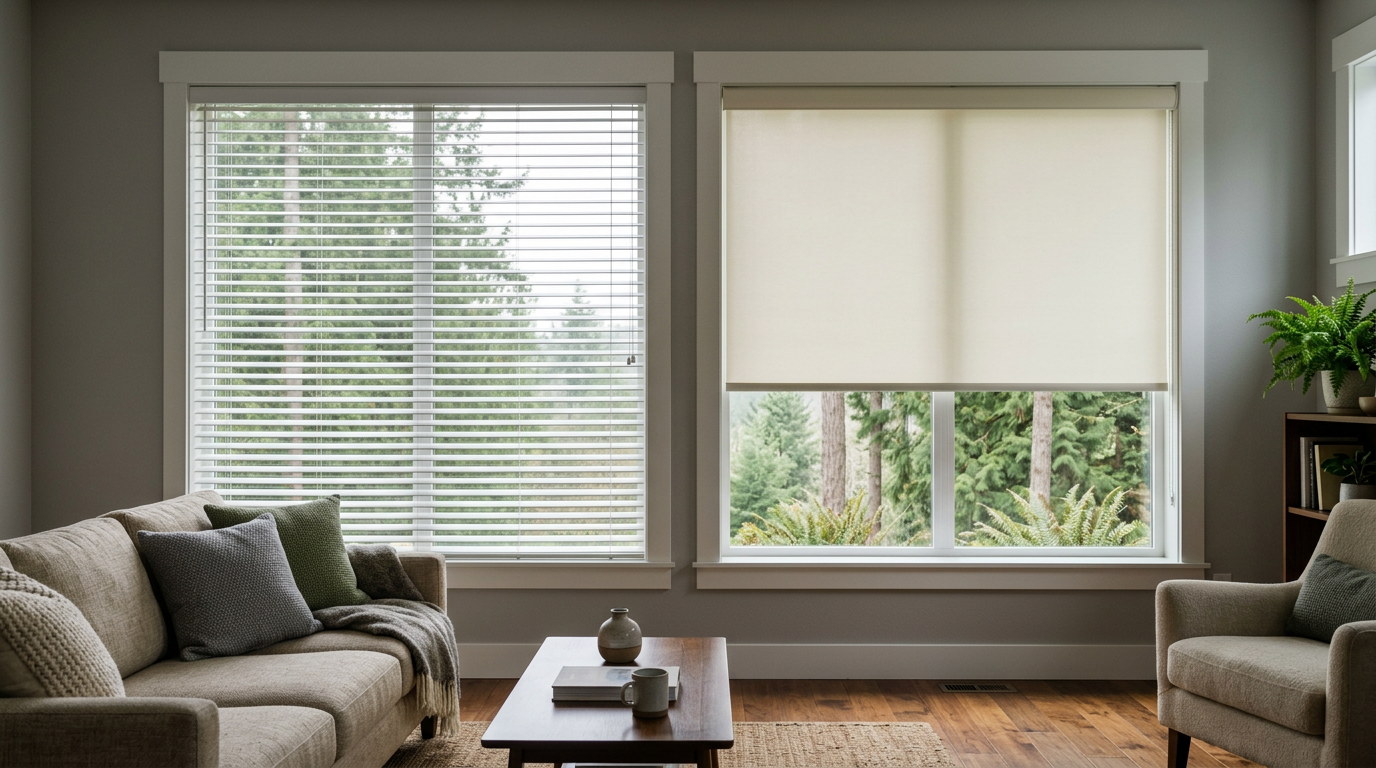
Blinds have hard slats you tilt. You control exactly how much light comes in and at what angle, and you can get privacy without going dark.
Shades are a continuous piece of fabric or material that rolls, folds, or stacks. Better insulation, softer look, usually cheaper, but light control is all or nothing rather than adjustable.
Quick answers to what people actually ask:
Most houses end up with both, and that is the right answer more often than people expect.
Direct answer: At the entry level, usually yes. Basic roller and pleated shades typically cost less per window than comparable blinds. At the premium end the two overlap heavily, and specialty shades like cellular, sheer, and banded shades often cost more than mid range wood blinds. Price tracks material, size, and whether you motorize far more than it tracks the blind-versus-shade choice.
The bigger cost variable is neither. It is window size and window count. A single oversized window can cost more than three ordinary ones.
Direct answer: Neither is better in general. Blinds win on adjustable light control, cleaning, and moisture resistance. Shades win on insulation, sound dampening, and a softer modern look. The right answer depends on the room, and most homes are best served by using both.
Anyone who tells you one is simply better is selling you the one they have in stock.
Blinds are built from individual slats, in wood, faux wood, aluminum, or vinyl, on a tilt mechanism. Raise them, lower them, or leave them down and tilt the slats. That third option is the whole point, and it is what no shade does. You get daylight bouncing off the ceiling while the people across the street see nothing.
Shades are one continuous piece of material that rolls onto a tube, folds into pleats, or stacks. No slats, no tilt. Up or down, and how far down.
That single mechanical difference drives everything else.
Direct answer: Blinds, without much argument. Tilting slats let you redirect light, cut glare from a low sun, and get daytime privacy while keeping the room bright. Shades control how much of the window is covered, but not the angle of the light coming through the part that is uncovered.
Where shades win is at the extremes. A blackout roller shade gets a room darker than any blind, because slats always leak light where they overlap and where the cords pass through.
Seattle makes this specific. Our winter sun sits low and comes in almost horizontally, so glare on a screen is a real problem in a way it is not in a sunnier city with a higher sun angle. Tilting slats handle that. So do solar shades, which is the one shade type built for exactly this.
Direct answer: Shades, clearly. Cellular or honeycomb shades trap air inside their cells and are the most energy efficient window covering available. Blinds have gaps between every slat, so air moves straight through them regardless of material.
This matters more here than most places. A lot of Seattle housing stock is old, single pane or early double pane, and drafty. If your heating bill is the reason you are shopping, that decides it. Look at cellular shades and stop comparing.
Direct answer: It depends on whether you want privacy with light or privacy with darkness. Blinds give you privacy while staying bright, by tilting the slats closed while the shade stays up. Shades give you complete privacy when fully lowered, but you lose the daylight along with the sightline.
For a street facing room in a dense neighborhood, blinds usually solve it better. For a bedroom, shades.
Direct answer: Shades read more current in 2026. Clean, uninterrupted fabric suits contemporary interiors, and the trend has run that way for a decade. But wood blinds in a Craftsman or a mid century home are not dated, they are correct. Matching the house beats chasing a trend.
Living room. Either works. Blinds if you want to manage glare through the day, shades if the room is more about how it looks and feels. Banded shades split the difference by alternating sheer and solid bands.
Bedroom. Shades, with a blackout or room darkening fabric. Blinds leak light at every slat, which matters at 5am in July when it gets light here before most people want it to.
Kitchen. Faux wood or vinyl blinds. They wipe clean when grease gets on them. Fabric shades near a range absorb cooking odor and are difficult to clean.
Bathroom. Faux wood or vinyl blinds, or a moisture rated shade. Real wood warps and fabric holds damp.
Home office. Blinds for glare control on a screen, or solar shades, which cut glare while keeping the view.
Nursery or kids' room. Cordless anything. This is a safety decision before it is a style one. Both blinds and shades come cordless and it is worth insisting on.
Choosing for the whole house at once. Rooms have different jobs. Buying one product for every window is how you end up with a bedroom that never gets dark.
Forgetting about cleaning. Faux wood blinds wipe down in minutes. Cellular shades cannot be washed at all and stains are largely permanent. If the window is somewhere messy, that should weigh heavily.
Buying blackout without checking the mount. A blackout shade on an inside mount still leaks light down both sides. If you genuinely need dark, you need an outside mount or side channels, and nobody mentions this until after installation.
Assuming cheaper means cheaper. A low cost covering that warps, yellows, or stops holding a set gets replaced in three years. That is not the cheaper option.
If you want a single rule: shades for rooms you want dark or warm, blinds for rooms you want bright and adjustable.
If you want the honest version: most homes want both, and the split usually falls out room by room within about ten minutes of someone standing in the house looking at the actual windows and the actual light.
That is what the free consultation is. Someone comes out, looks at each room, and tells you which is which. Nothing gets ordered until you have seen a quote.
At the entry level, usually yes. Basic roller and pleated shades typically cost less per window than comparable blinds. At the premium end they overlap, and specialty shades like cellular and sheer often cost more than mid range wood blinds. Size and window count move price more than either choice.
Neither is better in general. Blinds win on adjustable light control, cleaning, and moisture resistance. Shades win on insulation, sound dampening, and a softer modern look. Most homes are best served using both, chosen room by room.
Blinds are made of individual slats on a tilt mechanism, so you can adjust the angle of incoming light. Shades are one continuous piece of fabric that rolls, folds, or stacks, with no tilt. That single mechanical difference drives every other difference between them.
Shades generally read more current, since uninterrupted fabric suits contemporary interiors. But wood blinds in a Craftsman or mid century home are period correct rather than dated. Matching the architecture matters more than following a trend.
Shades, clearly. Cellular or honeycomb shades trap air in their cells and are the most energy efficient window covering available. Blinds have gaps between every slat, so air passes through regardless of what they are made from.
Shades, with a blackout or room darkening fabric. Blinds leak light through the gaps between slats and around the cords. For genuine darkness you also need an outside mount or side channels, because an inside mount leaks light down both edges.
Faux wood or vinyl blinds. They wipe clean when cooking grease settles on them. Fabric shades near a range absorb odor and are difficult or impossible to clean properly.
Blinds give privacy while keeping a room bright, because you can tilt the slats closed with the blind still raised. Shades give complete privacy when fully lowered but you lose daylight with it. For street facing rooms blinds usually solve it better.
.png)
