


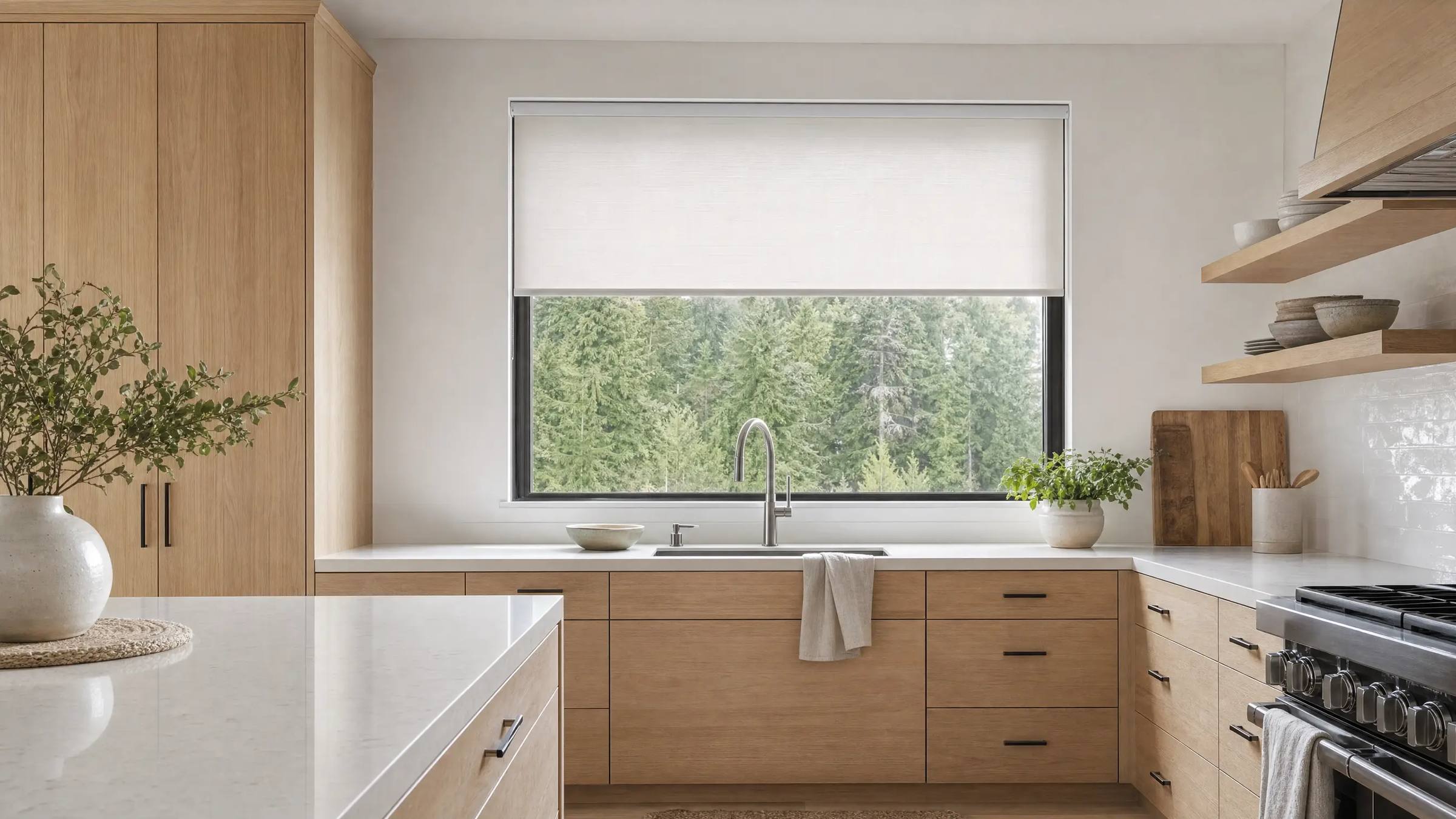
For a Seattle kitchen, the treatments that hold up best are the ones built to handle moisture and grease without losing their finish: faux wood blinds, Palm Beach Polysatin shutters, and roller shades in a wipeable fabric. Fabric options like Roman shades and sheer shadings work well in kitchens that sit away from the stove and sink, where a soft look matters more than wipe-down durability. The right choice for your kitchen usually comes down to how close the window sits to water and heat, not personal style alone.
A kitchen window deals with steam, splashes, cooking oil in the air, and bigger day-to-day temperature swings than a living room or bedroom sees. That combination is hard on materials that aren't built for it: real wood can swell or warp near a sink, and some fabrics hold onto grease in a way that's difficult to clean out. When we help Seattle homeowners choose kitchen treatments, the first question is always about proximity: how close is the window to the stovetop, the sink, or the prep counter. That answer narrows the material list fast.
The sink window gets more direct water exposure than any other window in the kitchen, and it's usually the one people regret choosing fabric for. Faux wood blinds and roller shades in a wipeable fabric are the two most forgiving options here, since both can be wiped down with soap and water without damaging the finish. If you want a softer look at that window, Polysatin shutters handle splash and humidity the same way faux wood blinds do, without the plastic look some homeowners want to avoid.
Many Seattle kitchens open onto a sliding glass door, and that's a different sizing and mounting problem than a standard window. Vertical treatments are the usual answer, since they draw to the side the same way the door opens, and a wide roller shade can also work. Either way, get the width measured carefully at your consultation. A slider is one of the more common places where an off-the-shelf size simply doesn't fit.
Light wood cabinetry generally pairs best with window treatments in a similarly light, neutral tone, since a strong contrast in color or wood tone tends to compete with the cabinetry instead of complementing it. Woven wood shades in lighter reed or bamboo tones can echo the warmth of light wood without matching it exactly. For a cleaner, more modern kitchen, a plain light-colored roller shade or a Roman shade in a solid neutral fabric keeps the window quiet and lets the cabinetry and countertops do the visual work. Bolder patterns and darker fabrics are better saved for a kitchen with darker or more saturated cabinetry, where they read as an intentional contrast rather than a clash.
Faux wood blinds and Polysatin shutters are the two most durable choices for a kitchen, and both resist fading, warping, and yellowing better than real wood. Faux wood blinds wipe clean with soap and water. Polysatin shutters carry the same moisture resistance in a more substantial, built-in look, which is worth considering for a kitchen window that's a visible focal point rather than a background element.
Honeycomb shades add real insulation value at the window, which matters through Seattle's cooler, damp stretches of the year. The cell structure traps air and helps even out the temperature swing near a drafty or older kitchen window. They're available in a wide range of light control levels, from sheer to blackout. Our honeycomb shades buying checklist covers cell sizes and fabric choices in more depth.
Roller shades in a wipeable fabric are the simplest option for a kitchen, and they have a clean, minimal look that doesn't compete with cabinetry or backsplash tile. They're a strong default for a window near prep or cooking areas where you want something functional first and decorative second.
Woven wood shades bring texture from natural materials like bamboo, grasses, and reeds, which works well against stainless appliances and other hard modern surfaces. They hold their shape well even in a sunny kitchen window. Pair one with a light-filtering or room-darkening liner if you want more control over privacy without losing the texture.
For a kitchen window that sits away from the stove and sink, such as a breakfast nook or a kitchen-adjacent dining window, Roman shades and sheer shadings like Silhouette and Pirouette bring a softer look that fabric-forward homeowners often want. These aren't the first choice directly over a heat or water source, but in the right spot they add warmth a hard window covering can't.
Different materials need different care. Faux wood blinds and wipeable roller shade fabrics can be wiped down with warm water and a little dish soap. Cellular and honeycomb shades should be vacuumed on the lowest setting with a brush attachment and never wet or scrubbed. Fabric Roman shades should be vacuumed and spot-cleaned only, tested on a hidden section first. A kitchen window generally needs more frequent attention than the rest of the house, simply because of what's in the air around it.
The right treatment for your kitchen depends on where the window sits relative to water and heat, how much light control and privacy you need, and the look you want against your cabinetry. During a free in-home consultation, we bring samples directly to your kitchen so you can see how they read against your actual cabinets, counters, and light. Contact us to schedule one, or visit our Redmond or Lynnwood showroom to see the full range in person.
Faux wood blinds, Polysatin shutters, and roller shades in a wipeable fabric hold up best around moisture and grease. Roman shades and sheer shadings work well in kitchen spots away from the stove and sink, like a breakfast nook.
Light, neutral-toned treatments generally pair best with light wood cabinetry, since a strong color or tone contrast competes with the cabinetry instead of complementing it. A plain light roller shade, a neutral Roman shade, or a lighter woven wood shade are all good starting points.
Faux wood blinds and wipeable roller shades are the most forgiving choice, since both wipe clean with soap and water. Polysatin shutters are a good option if you want a softer, more built-in look with the same moisture resistance.
Vertical treatments are the usual answer, since they draw to the side the same way the door opens. A wide roller shade can also work. Get the width measured at a consultation, since sliders are one of the more common windows that don't fit an off-the-shelf size.
Not if they're placed away from direct heat and water, such as a breakfast nook or dining-adjacent window. Roman shades and sheer shadings like Silhouette and Pirouette work well there. Near the stove or sink, a wipeable option is the safer choice.
It depends on the material. Faux wood blinds and wipeable roller shades clean up with warm water and dish soap. Cellular and honeycomb shades should only be vacuumed on low suction, never wet. Fabric Roman shades should be vacuumed and spot-cleaned, tested on a hidden section first.
Yes. The honeycomb cell structure traps air at the window, which helps even out temperature swings near a drafty or older kitchen window during Seattle's cooler, damp months.
Have more questions? Seattle Blinds offers free in-home consultations across the greater Seattle area.
Carly Zeller is the owner of Seattle Blinds, a Hunter Douglas dealer serving the greater Seattle area with custom window treatment solutions.

